Section 7E Struck Down by Court: What Every Property Owner in Pakistan Must Know
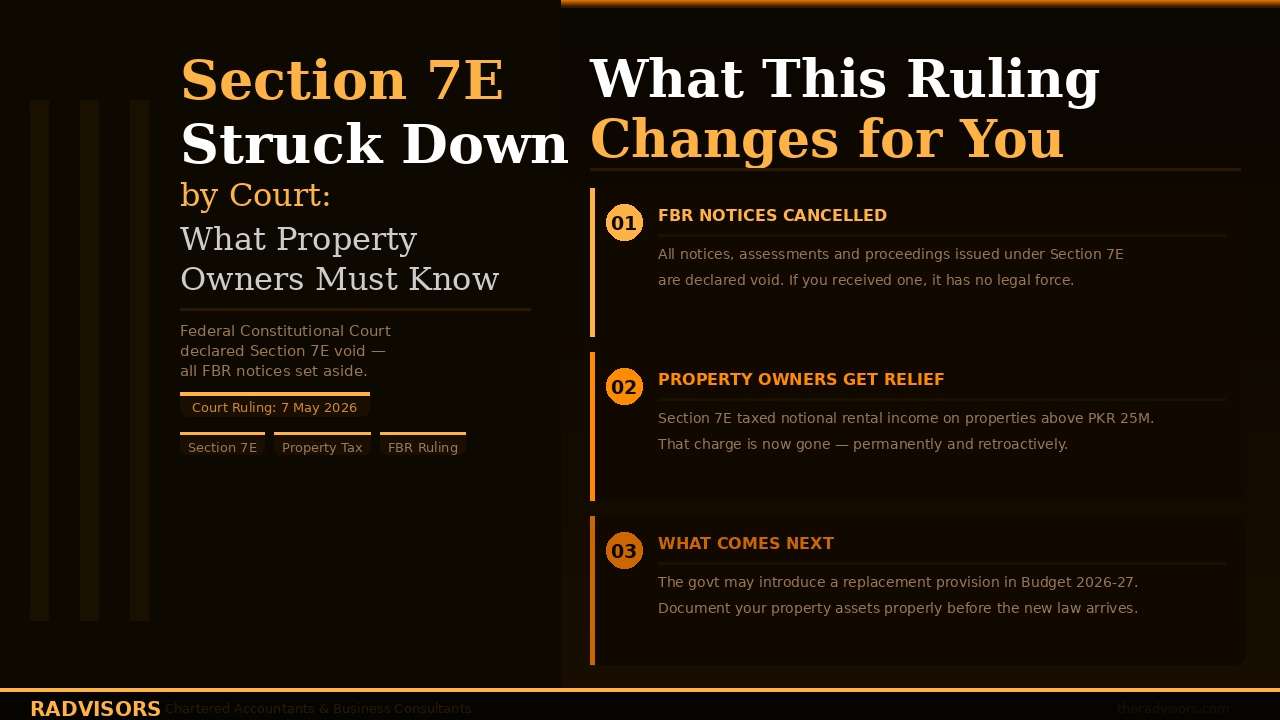
On 7 May 2026, the Federal Constitutional Court delivered one of the most important tax rulings in Pakistan’s real estate history. The court declared Section 7E of the Income Tax Ordinance 2001 unconstitutional and void from the beginning, providing significant relief to property owners across the country.
The judgment also cancelled every notice, assessment, and proceeding initiated by the Federal Board of Revenue (FBR) under Section 7E.
For taxpayers, investors, and real estate owners in Pakistan, this decision has immediate financial and legal implications.
What Was Section 7E?
Section 7E was introduced through the Finance Act 2022 and became applicable from Tax Year 2023.
The provision introduced the concept of deemed income on immovable property. Under this mechanism, the government assumed that property owners earned rental income even if the property was not rented out.
The law treated property owners as having earned income equal to:
Deemed Income=5%×Fair Market Value of Property
A tax rate of 20 percent was then applied to this notional income.
Who Was Affected by Section 7E?
The law generally applied to:
- Properties valued above PKR 25 million
- Commercial properties
- Open plots
- Multiple residential properties
- Inherited immovable assets
However, certain exemptions were available, including:
- One personal residence
- Agricultural land
- Specific exempt categories under the ordinance
Despite these exemptions, thousands of taxpayers received notices from FBR demanding tax on income they had never actually earned.
What Did the Federal Constitutional Court Decide?
The Federal Constitutional Court ruled that Section 7E was:
- Unconstitutional
- Beyond lawful authority
- Void from the outset
The court further held that:
- All notices issued under Section 7E are invalid
- All assessments and proceedings stand cancelled
- FBR actions under this section have no legal effect
This ruling follows earlier decisions by the:
- Peshawar High Court
- Balochistan High Court
Both courts had previously declared Section 7E unconstitutional. The latest judgment now settles the matter nationwide.
What This Means for Property Owners in Pakistan
1. FBR Notices Under Section 7E Are No Longer Valid
If you received a notice or demand from FBR under Section 7E, it is now legally void.
You cannot be penalised for non-compliance with those notices.
2. Previously Paid Tax May Be Recoverable
Taxpayers who already paid tax under Section 7E may now have grounds to seek:
- Refund applications
- Adjustments against future tax liabilities
- Amended tax returns
Each case may differ depending on how the payment was made and how FBR responds after the ruling.
3. Filed Returns Should Be Reviewed
If your income tax return for Tax Year 2023 onward included Section 7E calculations, it is advisable to review the filing position with a tax consultant or chartered accountant.
Many taxpayers may have overpaid taxes unnecessarily.
Will the Government Introduce a Replacement?
Although Section 7E has been struck down, the broader policy objective of taxing property wealth may not disappear.
The federal government is expected to address this issue in the upcoming:
- Finance Bill 2026-27
- Federal Budget 2026-27
The newly established Tax Policy Office under the Finance Division may propose a revised and constitutionally stronger framework for property taxation.
Therefore, property owners should remain cautious and compliant with tax documentation requirements.
What Property Owners Should Do Now
Review Your Tax Position
Property owners should immediately:
- Review previously filed tax returns
- Check Section 7E tax payments
- Preserve payment records and notices
- Evaluate refund eligibility
Maintain Active Filer Status
In Pakistan, active taxpayers continue to receive lower tax rates and better treatment in almost every property-related transaction.
Maintaining active filer status remains essential for:
- Property purchases
- Sale transactions
- Banking matters
- Future tax reliefs
Consult a Qualified Tax Advisor
Because the practical implementation of this ruling may evolve, professional tax advice is strongly recommended before filing refund claims or amended returns.
Final Thoughts
The striking down of Section 7E represents a landmark development for Pakistan’s real estate and taxation landscape. The judgment provides immediate relief to thousands of taxpayers who were facing tax liabilities on unrealised income.
However, the story is not over yet.
The government may soon introduce a revised property taxation framework in the upcoming federal budget. Property owners should therefore remain informed, compliant, and proactive in managing their tax affairs.
For professional guidance regarding taxation, compliance, and property-related advisory services in Pakistan, stay connected with The Radvisors.

Recent Posts

Best Bank Stocks in Pakistan 2026
Section 7E Struck Down by Court: What Every Property Owner in Pakistan Must Know