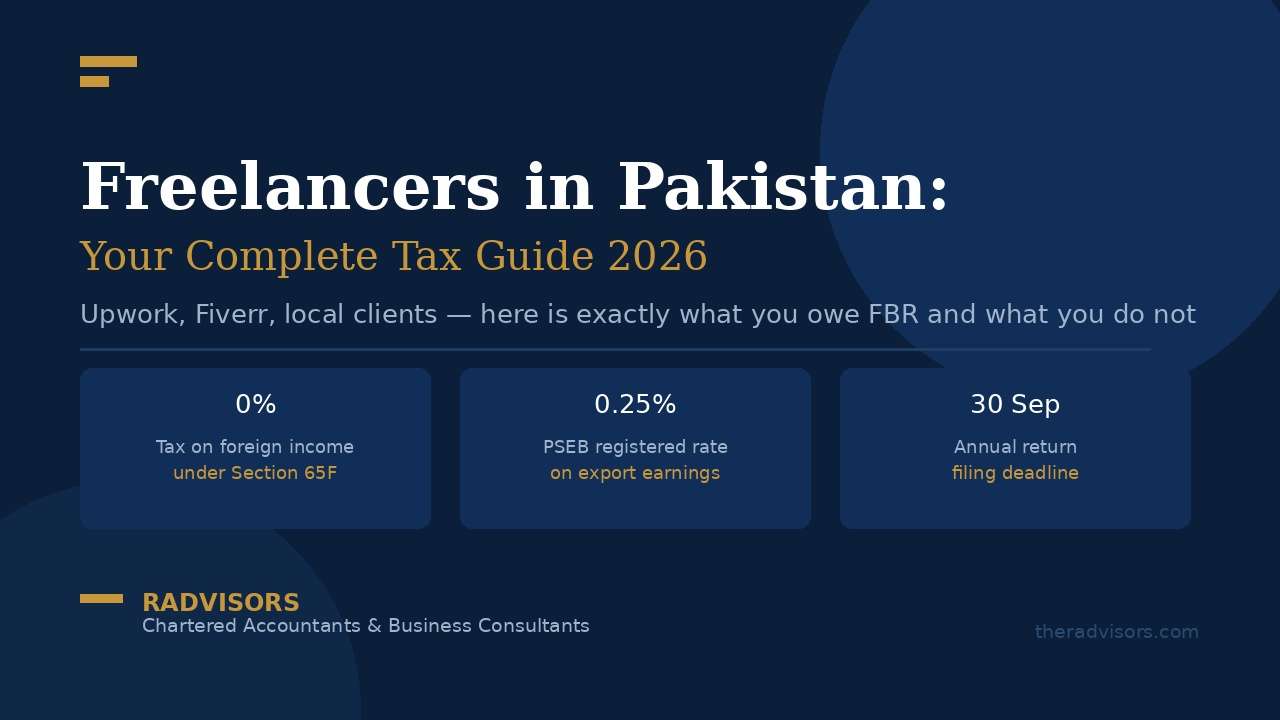
Freelancers in Pakistan: Your Complete Tax Guide for Tax Year 2026
Pakistan now has an estimated 2.4 million active freelancers, making it one of the fastest-growing freelance markets in Asia.
From Lahore and Karachi to Islamabad, Faisalabad, and smaller cities, freelancers are earning income through platforms such as:
- Upwork
- Fiverr
- Freelancer.com
- Direct international clients
- Remote IT and digital services
This sector generates significant foreign exchange for Pakistan. However, most freelancers still do not fully understand their tax obligations, exemptions, and legal benefits.
Some are overpaying tax.
Some are non-compliant without knowing it.
And many are missing legitimate exemptions that could reduce tax to near zero.
This guide explains everything clearly for Tax Year 2026.
Are Freelancers Required to Pay Tax in Pakistan?
Yes.
Under the Income Tax Ordinance 2001, any individual earning above the taxable threshold must:
- Register with the Federal Board of Revenue (FBR)
- File an annual income tax return
- Pay tax on taxable income
Freelance income is classified as business income, not salary.
This means freelancers are treated as self-employed individuals, responsible for:
- Calculating tax liability
- Maintaining records
- Filing annual returns independently
Tax-Free Threshold for Freelancers (2026)
For Tax Year 2026:
- Income up to PKR 600,000 is tax-free
Above this threshold, progressive tax slabs apply depending on total annual income.
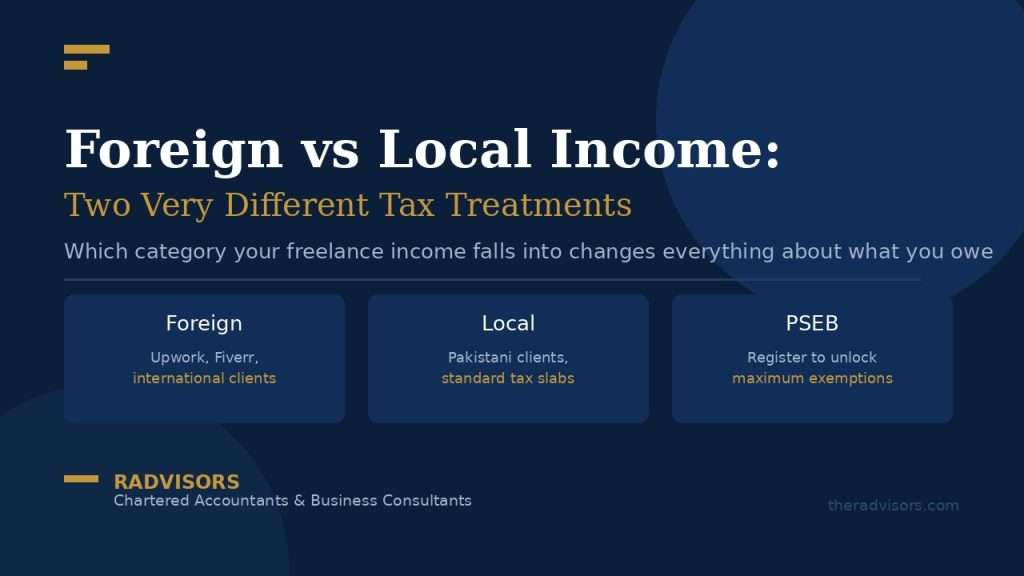
Foreign Income vs Local Income (Most Important Difference)
One of the most important tax concepts for freelancers is the distinction between:
- Foreign clients
- Local Pakistani clients
These are taxed very differently.
1. Foreign Income (International Clients)
Income from platforms like Upwork, Fiverr, or direct foreign contracts is treated as export of services.
Under Section 65F provisions of the tax law, eligible freelancers may qualify for:
- Up to 100% tax exemption on foreign income (subject to conditions and policy period)
- Preferential tax treatment for IT services exports
- Banking channel compliance requirements
Key Conditions:
- Income must be received through banking channels (Payoneer, Wise, bank transfer)
- Must qualify as IT or IT-enabled services
- Typically, majority income should be foreign-sourced
PSEB Registered Freelancers
Freelancers registered with the Pakistan Software Export Board benefit from reduced withholding tax:
- 0.25% final tax on foreign income (where applicable)
Without registration:
- Around 1% withholding tax may apply
This is a major legal tax-saving opportunity.
2. Local Income (Pakistani Clients)
Income from Pakistani clients is taxed under normal business income rules.
Additionally:
- Clients may deduct 10% withholding tax (Section 153)
- This withholding is adjustable against final tax liability
Local income is generally taxed at standard progressive slab rates.
W-8BEN Form for Freelancers
Freelancers using platforms like Upwork must submit the W-8BEN form.
Why it matters:
- Confirms non-US tax residency
- Prevents automatic 30% US withholding tax
- Enables application of tax treaty benefits
Without this form, freelancers may lose a significant portion of earnings unnecessarily.
How Freelance Tax Is Calculated (2026)
Tax depends on:
- Total annual income
- Income source (local vs foreign)
- Applicable exemptions
Example Scenario
A freelancer earning PKR 3.3 million annually:
- May pay significantly reduced tax under exemptions (65F / PSEB)
- Or higher tax under standard slabs if unregistered
👉 Proper structure can reduce tax from thousands to near-zero in some cases
Advance Tax for Freelancers
If annual tax liability exceeds PKR 50,000:
- Quarterly advance tax payments are required
- Due in: September, December, March, June
Failure to pay on time may result in:
- Surcharges
- Penalties
- Compliance issues
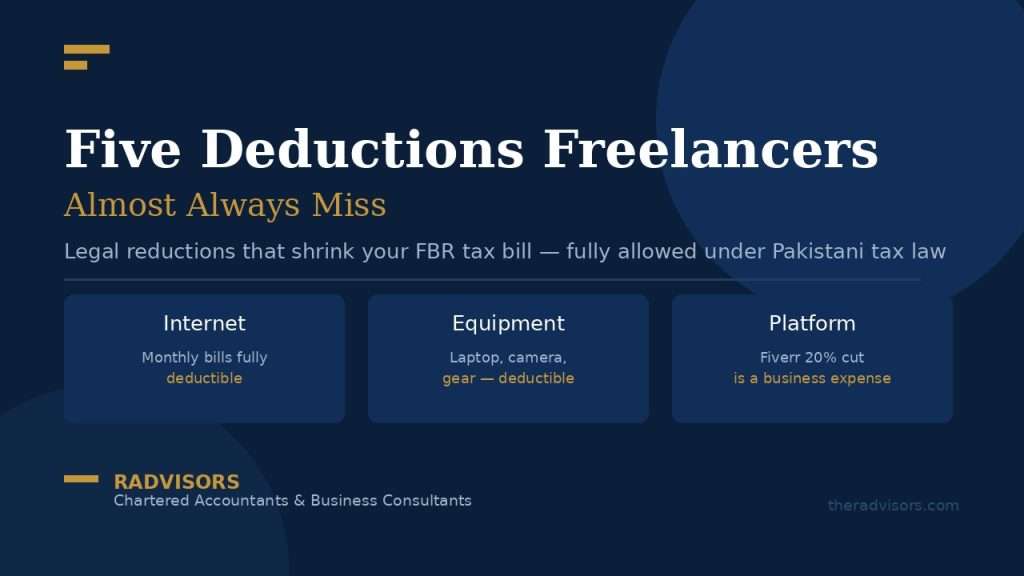
Deductions Freelancers Can Claim
Many freelancers overpay tax because they do not claim deductions.
Allowable expenses include:
Training and courses
Internet and mobile bills
Laptop and equipment (depreciation or full cost)
Fiverr / Upwork commissions
Software subscriptions (Adobe, tools, SaaS)
Electricity (business use portion)
Home office expenses (if applicable)
Important Requirement
All deductions must be supported with:
- Receipts
- Bank statements
- Invoices
Records must be retained for at least 6 years.
Why Most Freelancers Overpay Tax
Common mistakes include:
- Reporting gross income instead of net income
- Ignoring platform fees
- Not claiming business expenses
- Missing exemption eligibility
- Not registering with PSEB
These errors can significantly increase tax liability unnecessarily.
What Happens If You Do Not File Taxes?
The Federal Board of Revenue (FBR) now actively monitors:
- Foreign remittances
- Banking transactions
- Platform payments
Consequences of non-filing:
- Monetary penalties
- Higher withholding tax rates
- Restrictions on property and vehicle transactions
- Removal from Active Taxpayer List (ATL)
Non-compliance is no longer low-risk.
How Freelancers Can Become Compliant (Step-by-Step)
Step 1: NTN Registration
Register on FBR IRIS portal.
Step 2: PSEB Registration (if applicable)
Apply for freelancer recognition.
Step 3: Submit W-8BEN
Complete platform tax documentation.
Step 4: File Annual Return
Declare income, claim deductions, apply exemptions.
Key Takeaway
Freelancing in Pakistan is now a fully regulated income stream, but also one of the most tax-efficient if structured correctly.
The difference between:
- Proper compliance
- And informal filing
can mean thousands of rupees in unnecessary tax payments.
Conclusion
For freelancers in Pakistan, Tax Year 2026 is not about higher taxes — it is about better awareness and correct structuring.
Those who understand exemptions, deductions, and compliance requirements can significantly reduce their tax burden legally.
Those who do not risk:
- Overpaying tax
- Losing exemptions
- Facing penalties
Author Note
Prepared by a qualified Chartered Accountant with Big 4 audit and banking experience. Based on Income Tax Ordinance 2001, FBR regulations, and PSEB guidelines updated for Tax Year 2026.
About RAdvisors
RAdvisors provides freelancer tax registration, FBR filing, PSEB registration, and advisory services across Pakistan.
For personalized tax optimization and filing support, contact RAdvisors for a consultation.