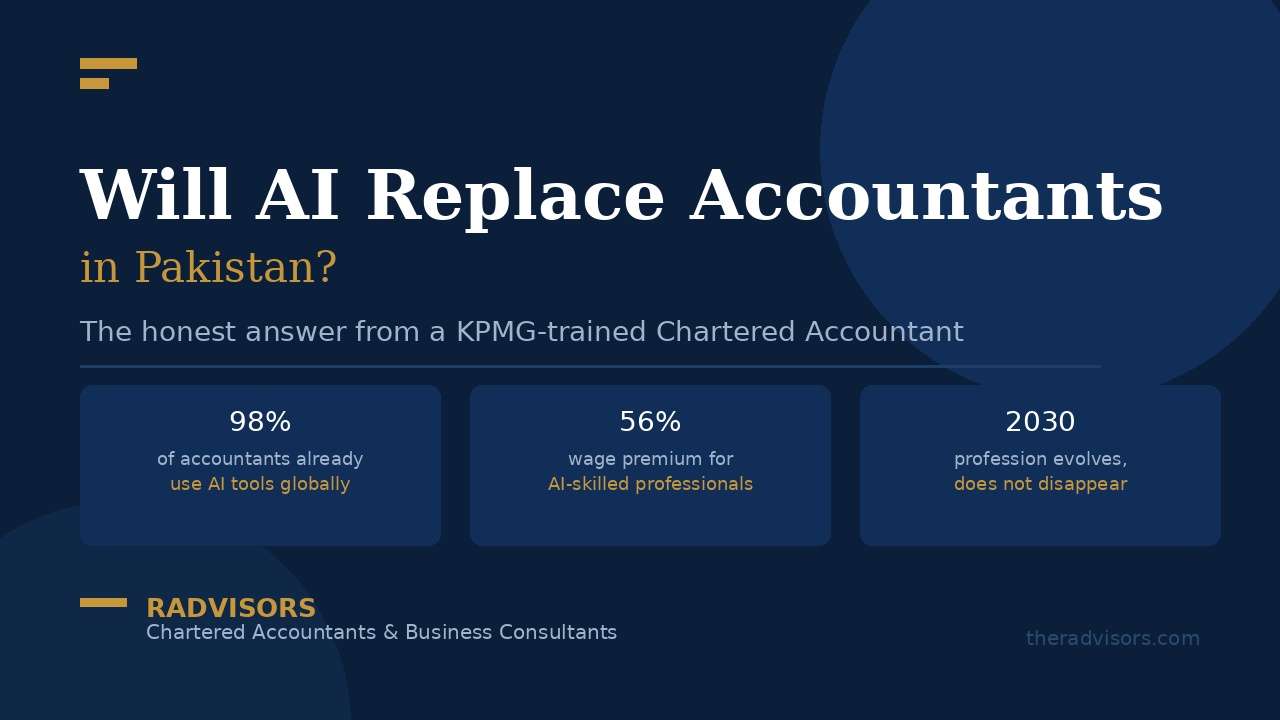
Scroll through any LinkedIn feed in Pakistan today and you will quickly notice a growing trend. One post warns accountants that their jobs are disappearing. Another headline claims that ChatGPT passed professional accounting exams. Meanwhile, comment sections are filled with worried students asking whether CA or ACCA is still worth pursuing. Important question arises, Will AI replace accountants in Pakistan? Learn how AI is changing CA and ACCA careers.
As a result, anxiety around artificial intelligence and the accounting profession has increased rapidly in Pakistan.
For thousands of students investing years of effort into qualifications like CA, ACCA, CFA, and finance degrees, the question feels deeply personal.
So let us answer it directly.
No, AI will not replace accountants in Pakistan. However, AI will absolutely replace accountants who refuse to understand and use technology.
That distinction is extremely important.
Why Are Accountants Worried About AI? The concern is understandable because artificial intelligence has improved very quickly.
Today, AI tools can already:
Draft financial summaries
Reconcile bank transactions automatically
Process invoices within minutes
Generate financial reports
Assist in tax calculations
Analyse large datasets rapidly
For example, software platforms like QuickBooks and Xero already automate tasks that once consumed hours of manual work.
Consequently, many professionals fear that automation could reduce accounting jobs.
However, most online discussions ignore one critical point:
Data entry is not the true value of a qualified accountant. What AI Is Actually Doing in Accounting Today Artificial intelligence is highly effective at repetitive and rules-based tasks involving structured financial data.
Currently, AI performs tasks such as:
Bank reconciliation
Invoice matching
Payroll calculations
Expense categorisation
Standard report generation
Basic tax computations
As a result, accounting firms can save significant time and reduce operational costs.
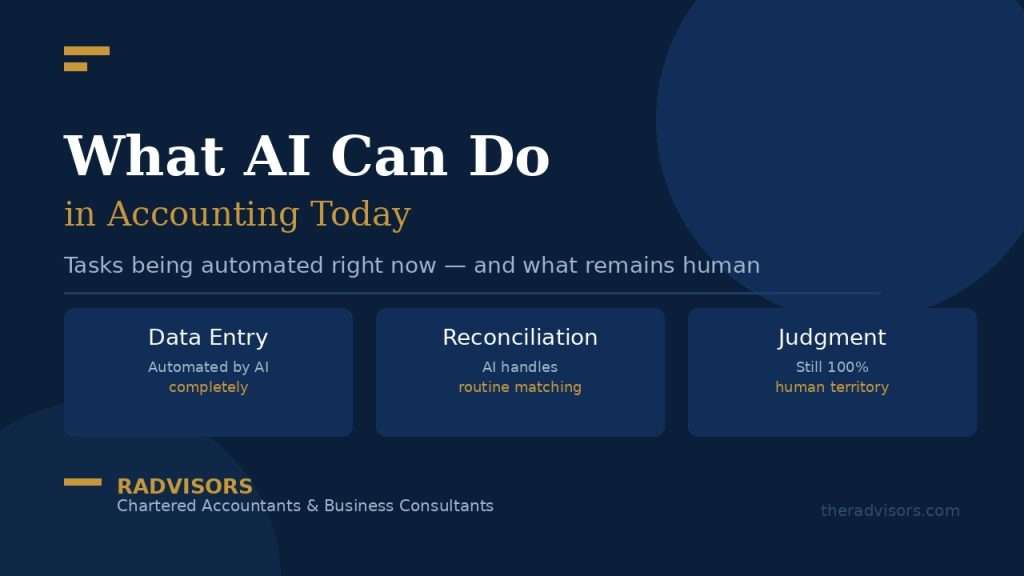
According to research published by ICAEW in 2025, nearly three-quarters of finance functions globally already use some form of AI to improve efficiency and decision-making.
Although Pakistan is slightly behind developed markets, adoption is increasing rapidly among:
- Big 4 firms
- Banks
- Microfinance institutions
- Multinational companies
- Large corporate groups
Therefore, the shift toward AI in accounting is already happening.
The Biggest Misunderstanding About AI and Accountants
Many people assume accounting is only about calculations and spreadsheets.
In reality, accounting is fundamentally about judgment.
That is precisely where artificial intelligence struggles.
A qualified accountant does much more than prepare numbers. They apply:
- Professional judgment
- Ethical reasoning
- Regulatory interpretation
- Strategic thinking
- Client advisory skills
These are deeply human capabilities.
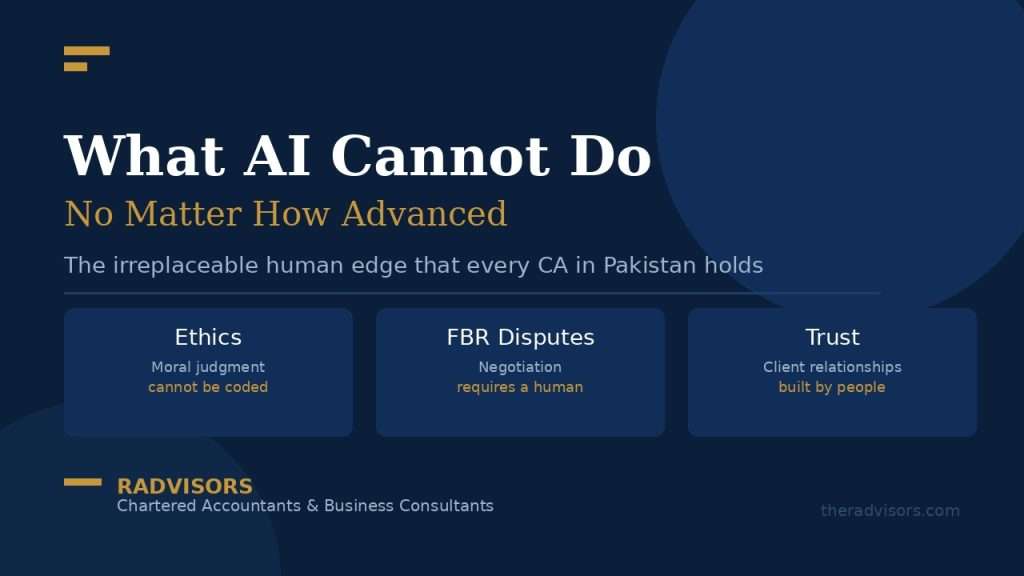
What AI Cannot Replace
Artificial intelligence can process information. However, it cannot replace professional responsibility and human judgment.
Consider a few real-world examples.
1. Handling Tax Notices from FBR
When a business owner receives a tax notice from Federal Board of Revenue, they do not simply need software.
Instead, they need a professional who understands:
- Tax laws
- FBR procedures
- Regulatory interpretation
- Practical negotiation strategies
- Documentation requirements
Most importantly, they need someone who can represent their interests professionally.
AI cannot negotiate with tax authorities like an experienced Chartered Accountant can.
2. Business Advisory and Financial Decisions
When a startup founder needs advice regarding financing structures, taxation, or expansion planning, the decision goes far beyond numbers.
The advisor must understand:
- Risk appetite
- Business strategy
- Regulatory implications
- Cash flow realities
- Market conditions in Pakistan
Therefore, accounting advisory remains heavily dependent on human experience and trust.
3. Audit and Regulatory Judgment
Modern audits involve complex professional standards such as IFRS and regulatory frameworks.
For example, audit opinions require:
- Materiality judgments
- Risk assessment
- Fraud considerations
- Ethical responsibility
- Professional scepticism
Even global firms like KPMG still rely on qualified professionals to sign audit reports.
AI can assist auditors. However, it cannot legally or ethically replace them.
What Research Actually Says About AI and Accounting Jobs
Many fear-driven headlines only tell part of the story.
In reality, research shows that accounting jobs are evolving rather than disappearing.
A 2025 study from Stanford University found that hiring for junior AI-affected accounting roles declined by around 16 percent over two years.
However, the research also revealed something important:
The jobs changed instead of disappearing.
Routine work decreased, while demand increased for professionals who could:
- Review AI outputs
- Analyse financial insights
- Handle exceptions
- Advise management
- Apply professional judgment
Furthermore, finance professionals with AI skills earned significantly higher salaries than those without technology expertise.
As a result, the market is rewarding accountants who understand AI tools.
Why Pakistan Is Different
Pakistan’s accounting environment makes full AI replacement even less likely.
The country operates within a highly complex regulatory system involving:
- FBR regulations
- SECP compliance
- Sales tax rules
- Income tax laws
- Corporate filing requirements
Moreover, many Pakistani SMEs still maintain incomplete or informal records.
Therefore, accountants frequently need to:
- Reconstruct transactions
- Interpret incomplete information
- Guide business owners
- Build financial systems manually
These tasks require communication, judgment, and practical experience.
AI alone cannot handle such situations effectively.
The Future of Chartered Accountants in Pakistan
For qualified accountants in Pakistan, AI should be viewed as an opportunity rather than a threat.
A modern accountant who combines:
- ICAP or ACCA qualification
- Financial expertise
- AI knowledge
- Accounting software skills
- Analytical capability
will become far more valuable in the coming years.
For example, professionals familiar with:
- QuickBooks
- Xero
- Power BI
- AI-assisted reporting tools
- Financial analytics platforms
can serve clients more efficiently and professionally.
Consequently, technology-literate accountants are likely to earn more and grow faster.
Skills Accountants Must Develop in 2026
To remain competitive, accounting professionals should focus on developing:
Technical Skills
- Financial analysis
- Taxation
- Audit expertise
- IFRS knowledge
Technology Skills
- AI tools
- Cloud accounting software
- Excel automation
- Data analytics
- Power BI
Human Skills
- Communication
- Advisory capability
- Negotiation
- Leadership
- Critical thinking
Ultimately, the future belongs to accountants who combine technical knowledge with technology and advisory skills.
Final Verdict: Will AI Replace Accountants in Pakistan?
The honest answer is no.
AI will automate repetitive accounting tasks. Furthermore, entry-level work will continue evolving over time.
However, the core value of a professional accountant has never been simple data entry.
The real value lies in:
- Judgment
- Trust
- Ethics
- Advisory
- Regulatory expertise
- Decision-making support
These are areas where human professionals remain essential.
Therefore, accountants who embrace AI will not become obsolete. Instead, they will become more productive, more valuable, and more competitive.
The real risk is not artificial intelligence itself.
The real risk is refusing to adapt.
Conclusion
Artificial intelligence is already transforming accounting in Pakistan. Nevertheless, the profession itself is not disappearing.
Instead, the role of accountants is evolving from manual processing toward higher-value advisory and analytical work.
For CA, ACCA, and finance students, the message is clear:
Learn AI. Use technology. Strengthen your advisory skills.
Because the accountants who combine professional expertise with AI tools will lead the future of Pakistan’s finance industry.
Disclaimer
This article is for educational and informational purposes only and reflects professional industry analysis based on publicly available research and market observations as of 2026.
Reviewed and Written By
Prepared by a qualified Chartered Accountant with experience in:
- Big 4 audit
- Banking
- Microfinance
- Financial advisory
- Taxation and compliance
Research references include professional publications from ICAEW, Stanford University, and the World Economic Forum.
For audit, taxation, accounting, and financial advisory services in Pakistan, visit The Radvisors.