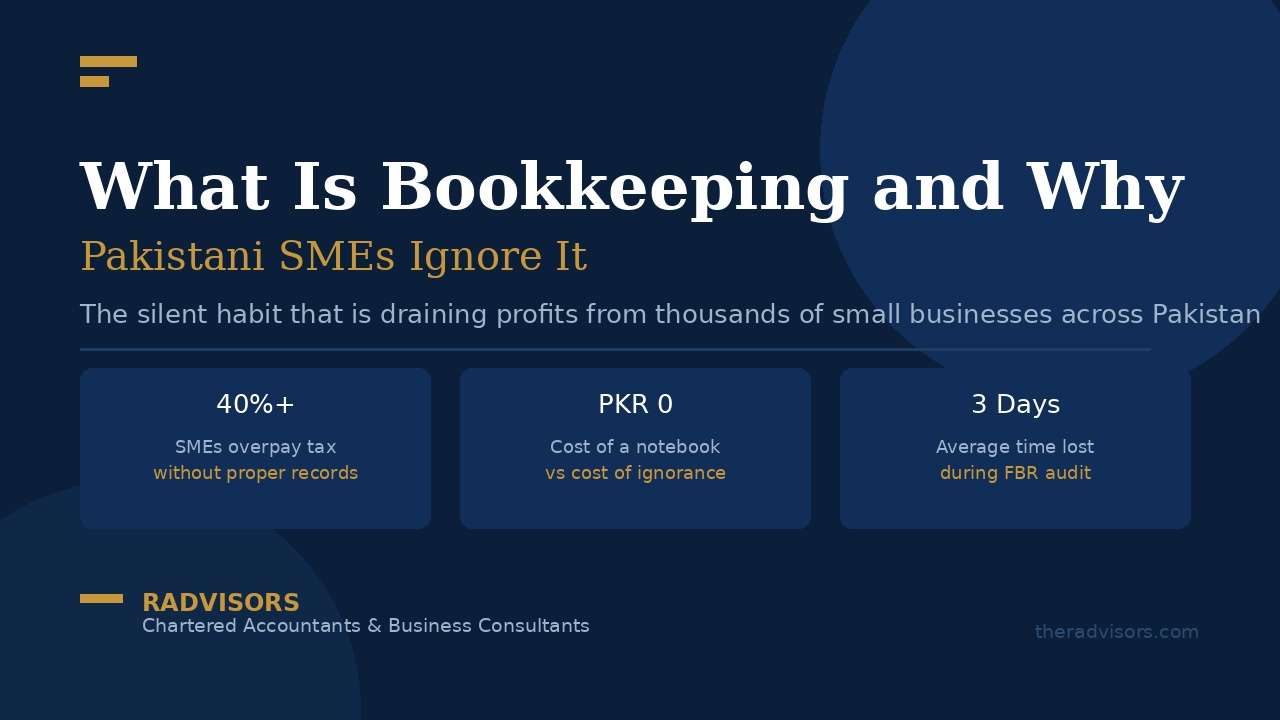
What Is Bookkeeping and Why Pakistani SMEs Keep Ignoring It, At Their Own Cost
Walk into almost any small business in Pakistan — a shop in Lahore’s Liberty Market, a retailer in Karachi’s Walk into almost any small business in Pakistan — a shop in Lahore’s Liberty Market, a retailer in Karachi’s Saddar, a printing press in Rawalpindi, or a home-based consultancy in Islamabad — and ask a simple question:
“Do you maintain proper financial records?”
Most business owners will say yes.
But when asked to show last month’s profit, expenses, or cash flow, the answer is often unclear.
In reality, many SMEs are running on informal systems:
- Notebooks
- WhatsApp messages
- Unsorted receipts
- Memory-based tracking
This approach may work temporarily, but it becomes expensive over time.
What Bookkeeping Actually Means
Bookkeeping is the systematic recording of every financial transaction in a business.
This includes:
- Sales
- Purchases
- Expenses
- Payments received
- Payments made
- Bank transactions
It ensures every financial movement is recorded, categorized, and traceable.
Bookkeeping vs Accounting
These are not the same:
- Bookkeeping = Recording financial data
- Accounting = Interpreting financial data
Without bookkeeping, accounting becomes guesswork.
Without accounting, bookkeeping has no financial meaning.
Both are required for a financially healthy business.
Why Bookkeeping Matters for Pakistani SMEs
For most small businesses, bookkeeping is ignored because it seems unnecessary in early stages. But as the business grows, the absence of records creates serious financial problems.
1. SMEs End Up Paying Higher Taxes
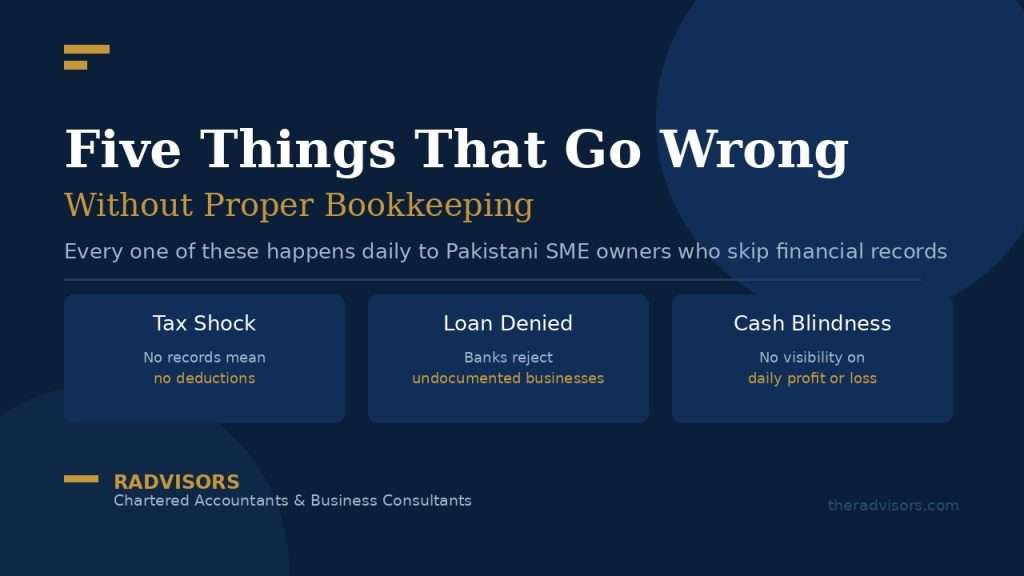
One of the most common consequences is overpayment of tax.
Many expenses that are legally deductible under Pakistan tax law are never recorded, such as:
- Rent
- Utilities
- Salaries
- Marketing costs
- Travel and fuel expenses
- Professional fees
Without proper records, these deductions cannot be claimed, which increases taxable income artificially.
This results in businesses paying more tax than required under the Income Tax Ordinance 2001.
2. Banks Reject Loan Applications
When SMEs apply for financing, banks require:
- Profit and loss statements
- Balance sheets
- Cash flow statements
- Financial history
Businesses without bookkeeping cannot provide these documents.
As a result:
- Loan applications are rejected
- Growth plans are delayed
- Businesses rely on expensive informal borrowing
Poor bookkeeping directly limits access to formal credit.
3. FBR Compliance Becomes Risky
Under the Federal Board of Revenue (FBR):
Businesses are required to maintain financial records for at least six years.
Without proper bookkeeping:
- Audit defense becomes impossible
- Income is estimated by authorities
- Tax assessments are usually higher
- Penalties and surcharges may apply
Lack of records shifts control from the business owner to the tax authority.
4. Business Profitability Becomes Unclear
Without structured records, many business owners:
- Confuse revenue with profit
- Misjudge product profitability
- Underprice services
- Overspend on inventory
- Make hiring decisions without data
A business can appear successful but still be losing money.
This is one of the most common causes of SME failure in Pakistan.
Notebook Records Are Not Bookkeeping
Many SMEs believe they are already maintaining records.
But true bookkeeping is not:
- A notebook of daily sales
- WhatsApp messages to an accountant
- Random Excel sheets
- Memory-based tracking
Proper bookkeeping requires:
- Daily transaction recording
- Categorized expenses and income
- Supporting documentation (receipts/invoices)
- Bank reconciliation
- Separation of personal and business finances
Without these, records are incomplete and unreliable.
Why Separation of Personal and Business Money Is Critical
One of the biggest mistakes SMEs make is mixing:
- Personal expenses
- Business accounts
This creates:
- Unclear financial statements
- Incorrect tax reporting
- Audit complications
- Poor cash flow visibility
A dedicated business bank account is essential for accurate bookkeeping.
Simple Bookkeeping Discipline That Works
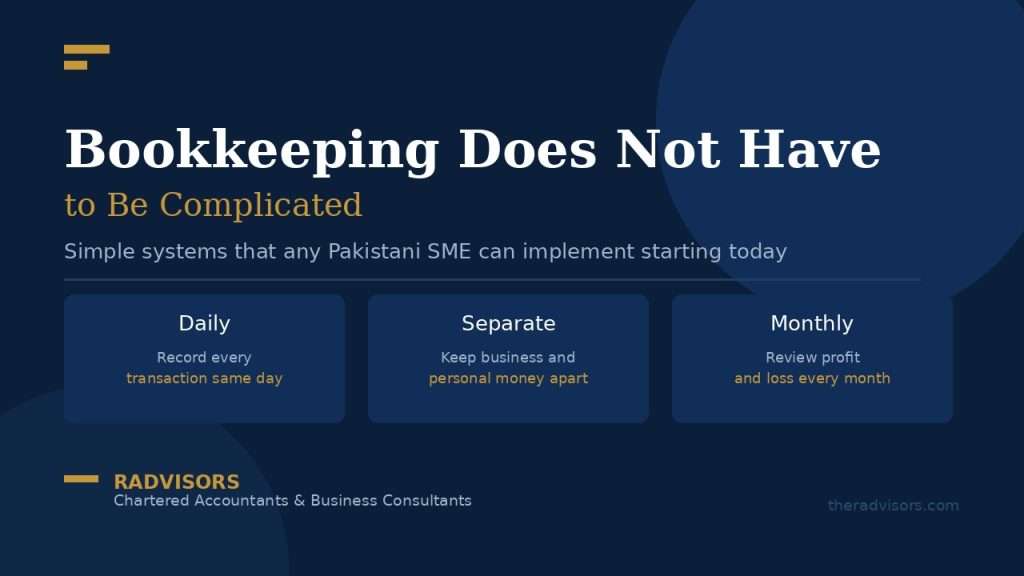
Bookkeeping does not need to be complex.
1. Record Transactions Daily
Every sale and expense should be recorded on the same day.
2. Keep Business Bank Account Separate
All business transactions should flow through one account.
3. Save All Receipts
Invoices and receipts should be stored for at least 6 years.
When SMEs Should Use Software
As businesses grow, manual systems become inefficient.
Tools like:
- QuickBooks
- Xero
- Wave
help automate:
- Expense tracking
- Invoice generation
- Bank reconciliation
- Monthly reporting
This improves accuracy and saves time.
When Professional Help Becomes Necessary
Bookkeeping can be handled internally at a small scale.
However, professional support becomes necessary when:
- Sales tax returns are required
- Payroll becomes complex
- Inventory management is involved
- Multiple income streams exist
- Compliance risk increases
At this stage, bookkeeping is not optional — it becomes part of business infrastructure.
FBR Digital Monitoring Is Increasing
Pakistan’s tax system is becoming more integrated with:
- Banks
- NADRA
- Payment systems
This means financial inconsistencies are easier to detect than before.
Businesses without proper records face higher compliance risk in 2026 and beyond.
The Real Cost of Ignoring Bookkeeping
Poor bookkeeping leads to:
- Higher taxes
- Lost financing opportunities
- Compliance penalties
- Poor decision-making
- Hidden financial losses
These costs often exceed the cost of proper bookkeeping services.
Conclusion
Bookkeeping is not an administrative burden — it is a financial control system.
For Pakistani SMEs, it is the difference between:
- Guessing vs knowing
- Surviving vs scaling
- Compliance vs risk
The businesses that grow in 2026 will not necessarily be the biggest — they will be the ones with the clearest financial records.
Author Note
Prepared by a qualified Chartered Accountant with Big 4 audit and banking experience. Based on Pakistani tax law, FBR compliance requirements, and SME financial reporting standards applicable in 2026.
About RAdvisors
RAdvisors provides bookkeeping, accounting, tax compliance, and financial advisory services for SMEs across Pakistan.
For professional bookkeeping setup or cleanup, contact RAdvisors for a consultation.