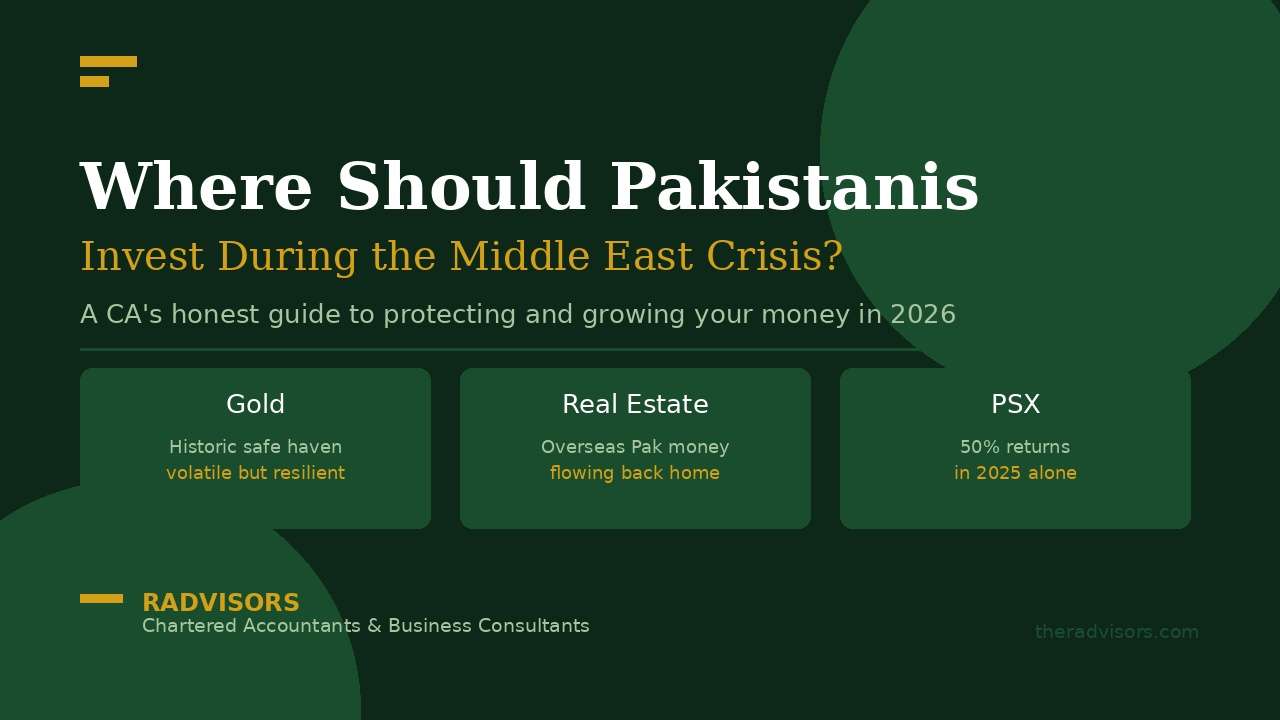
Where Should Pakistanis Invest Their Money During the Middle East Crisis? (2026 Guide)
The question is dominating investor conversations across Pakistan in 2026.
With war-related tensions in the Middle East, volatile oil prices, a weakening rupee, and sharp movements in the stock market, investors are facing one of the most uncertain financial environments in recent years.
During periods like this, most investors react in two ways:
- Panic selling everything
- Doing nothing and waiting
Both approaches often lead to poor financial outcomes.
This article does not predict geopolitical outcomes. Instead, it provides a structured and realistic breakdown of where Pakistanis can invest money during the Middle East crisis, based on risk, return, and stability.
What Happened to Markets During the Crisis
When conflict escalated in early 2026, global and local markets reacted immediately.
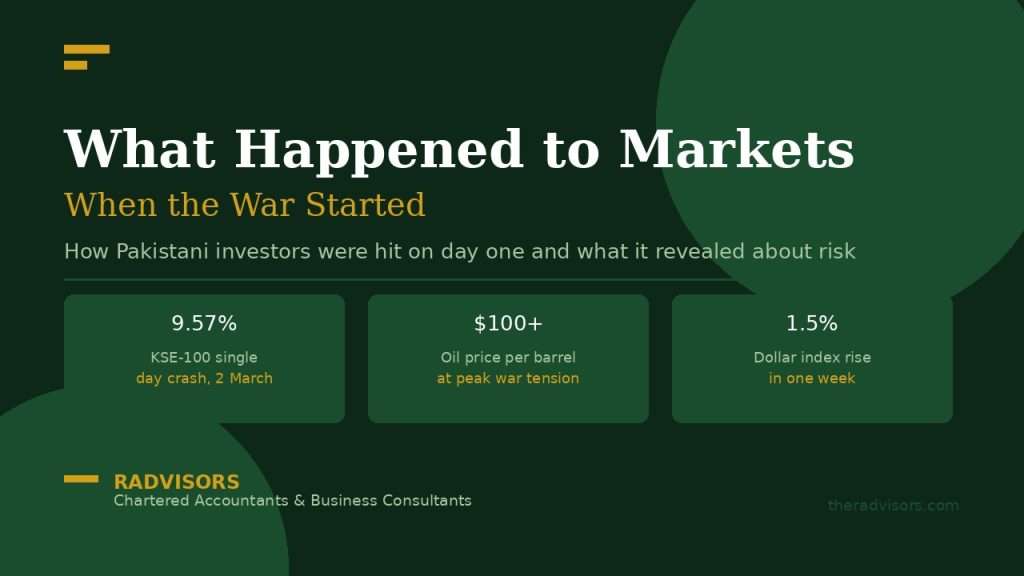
The KSE-100 Index recorded one of its sharpest single-day declines, falling nearly 10% in a single session.
At the same time:
- Oil prices surged above USD 100 per barrel
- Global currencies became volatile
- Gold prices fluctuated sharply
- Investor sentiment weakened
For Pakistani investors, the impact was immediate:
- Portfolio losses in equities
- Higher inflation expectations
- Rising fuel and transport costs
- Increased currency risk
However, the real lesson was not the fall itself — but how investors reacted to it.
Pakistan’s Economic Position in 2026
Before choosing investments, it is important to understand the macro backdrop.
Pakistan entered this crisis with:
- Moderating inflation compared to 2023 peaks
- Policy rate around 10–12% range
- Gradually improving foreign reserves
- High dependence on imported oil
- Strong reliance on remittances from Gulf countries
Two structural vulnerabilities matter most:
- Oil import dependency
- External remittance exposure
These directly connect Pakistan’s economy to Middle East instability.
1. Government Securities (Low Risk Option)
For conservative investors, government securities remain the most stable option.
These are available through Investor Portfolio Securities (IPS) accounts linked with the State Bank of Pakistan.
Why investors choose them:
- Returns around 10–11% annually
- Backed by government credit
- No stock market volatility
- Full rupee-based safety
Best for:
- Capital preservation
- Retired individuals
- Low-risk portfolios
This is not a high-growth investment, but it is a stability-first strategy.
2. Gold (Traditional Safe Haven)
Gold remains one of the most widely used hedges in Pakistan.
Why gold matters in crises:
- Protects against inflation
- Hedge against currency depreciation
- Culturally trusted asset
However, gold is not always stable in the short term.
Key reality in 2026:
- Prices have shown volatility despite crisis conditions
- Global dollar strength can offset gains
- Supply disruptions temporarily impact local pricing
Best for:
- Long-term wealth preservation
- Portfolio diversification
- Inflation protection
Gold works best as a long-term holding, not a trading instrument.
3. Pakistan Stock Market (High Risk, High Opportunity)
The stock market remains volatile but also offers selective opportunities.
After the crisis escalation, the KSE-100 saw a sharp correction but remains fundamentally driven by sector performance rather than short-term panic.
Key insight:
Not all sectors behave the same.
More resilient sectors:
- Banking
- IT exports
- Selected agriculture-related companies
More vulnerable sectors:
- Fuel-intensive industries
- Import-heavy manufacturers
- Logistics and transport businesses
Best for:
- Medium to long-term investors
- Investors with risk tolerance
- Sector-focused strategies
Stock market investing now requires selectivity, not broad exposure.
4. Real Estate (Income + Stability Focus)
Real estate remains a major investment class in Pakistan, especially for overseas Pakistanis.
However, the market has shifted.
What is changing:
- Speculative buying has reduced
- End-user demand is stronger
- Rental income focus is increasing
Better-performing segments:
- DHA developments
- Bahria Town projects
- Urban apartments with rental demand
Best for:
- Long-term investors
- Rental income seekers
- Overseas Pakistanis repatriating capital
Real estate now rewards utility over speculation.
5. Mutual Funds (Balanced Risk Option)
Mutual funds offer professional management and diversification.
Types to consider:
- Balanced funds
- Income funds
- Diversified equity funds
Advantages:
- Professional portfolio management
- Diversification across sectors
- Lower effort required
Risks:
- Management fees
- Market exposure still exists
- Liquidity varies by fund type
Best for:
- Passive investors
- Beginners
- Diversified portfolios
What Investors Should Avoid Right Now
During crisis periods, risk increases significantly in certain areas:
- Idle cash in zero-return accounts
- Unregulated or undocumented investments
- Highly leveraged trading positions
- Speculative real estate schemes
These carry disproportionate risk in unstable conditions.
The Bigger Picture for Pakistan
Despite volatility, Pakistan remains structurally positioned in a sensitive but strategically important region.
Key long-term factors include:
- Strategic location near trade routes
- Growing role in regional logistics
- Strong diaspora remittance base
- Emerging infrastructure development
However, short-term volatility will continue to shape investor behavior.
Final Investment Strategy for 2026
A balanced approach is more effective than aggressive positioning.
Suggested structure:
- Low risk: Government securities
- Medium risk: Mutual funds and real estate
- Higher risk: Selective equities
- Hedge: Gold
The goal is not maximum return.
The goal is portfolio survival with controlled growth.
Conclusion
The Middle East crisis has created uncertainty, but also opportunity.
Pakistan’s investors who perform best in 2026 will be those who:
- Stay diversified
- Avoid emotional decisions
- Focus on fundamentals
- Align investments with risk tolerance
Markets will remain volatile, but disciplined investing always outperforms reactionary behavior.
Author Note
Prepared by a qualified Chartered Accountant with Big 4 audit and banking experience. Analysis based on Pakistan Stock Exchange data, State Bank of Pakistan reports, and international economic research sources current as of May 2026.
About RAdvisors
RAdvisors provides financial advisory, investment planning, tax consultancy, and wealth management support for Pakistani individuals, SMEs, and overseas investors.
For personalized investment planning during volatile market conditions, contact RAdvisors for a consultation.